Montevideo Middle School STEM students build inclusive PE activities for peers
PENN LAIRD, Va. (WHSV) - Montevideo Middle School students helped create an inclusive gym class that’s adaptive to PE students with disabilities.
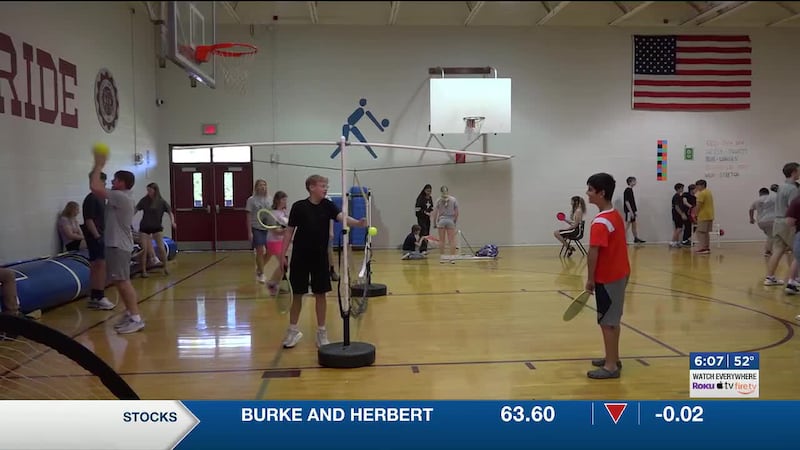
At Montevideo Middle School, students in the school’s STEM program worked to create new games designed for classmates with developmental or physical disabilities. Madison Allen, the health and PE teacher at Montevideo, said the collaborative project was an opportunity for students to see their peers who have disabilities “and understand they want those experiences” in PE as well.
“They don’t get to play games like we would in PE. It’s either not safe or they’re physically not able,” Allen said.
Students said the collaboration started with a reality they hadn’t always considered during a typical day in the gym.
The projects covered several familiar activities, such as baseball, bowling and soccer. Each activity was reimagined to adapt to different physical abilities. Students focused on ways to guide movement, provide support and keep the game consistent and easy to understand.
One group chose bowling, saying they wanted to create something that felt like a standard PE game while also giving players more control.
“Everyone was trying to get a different sport to choose from,” Jack Bentley, a student at MMS, said. “Since we chose bowling, we kind of went with a steering wheel design. We also wanted it to be inclusive of everyone. We didn’t want it to be just for one or two people, we wanted it for everyone in the class, and so, I think we kind of achieved that with our project.”
As the games came together, students said the building process was only part of the experience. The bigger moment came when they saw classmates try the activities and enjoy them, sometimes surprising the designers themselves.
“I was very glad to see everyone was able to enjoy it,” Camden Flory, an MMS student, said. “As we were all building these projects, everyone else’s looked very good and it seemed like ours was kind of on the more boring side. So, it was really nice to see that everyone was able to enjoy our project as they enjoyed everyone else’s.”
Staff said the project helped turn “inclusion” from an abstract idea into something concrete. It also showed how quickly a small change — like a different grip, a more stable base or a guided way to aim — can allow more students to play safely and increase accessibility.
“I’ve seen them since we started building them, and I’ve watched a couple of them in action,” Allen said. “Seeing them all together today, there were still parts that I wasn’t sure how they worked, and the kids adding them in — I didn’t even think about that, and it was a fantastic idea."
Teachers and staff said collaborations like this can also help students recognize that disabilities are not always obvious. A student may not use a wheelchair or have a visible condition but still deal with a challenge that affects how they participate in class.
“Students might not have a disability themselves, they might have a family member [who does],” Allen said. “Or they might have a disability you can’t see. They might have diabetes, they might have a mental health issue going on. It’s just as important to know that we can change things for them to be just as successful.”
The school received grant funding to help cover the cost of materials for the project, but staff emphasized that each activity was designed and handmade by the students. The work required planning, teamwork, creativity and some trial and error — skills that apply far beyond the classroom.
“The most fun was probably working with our friends and spilling out ideas and making them happen,” Sebastian Hess, a student at MMS, said.
Staff said the project delivered benefits on both sides: adaptive PE students had new ways to participate and enjoy class, while STEM students got a chance to apply engineering and problem-solving to a hands-on project that mattered to others.
Copyright 2026 WHSV. All rights reserved.